
Legal Education for Economic Stability
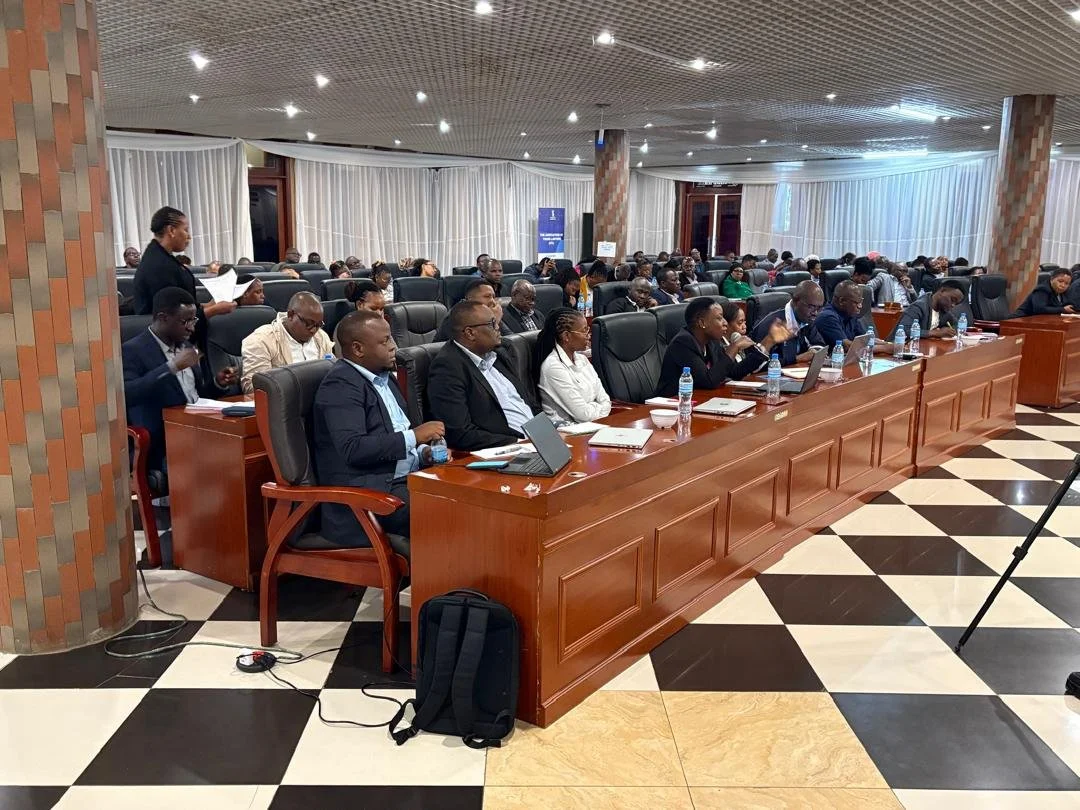
Tanzanian lawyers attend a legal training in Arusha in 2025
ARUSHA - Across the varied landscape of international law, there is, among attorneys, at least one commonality: Continuing legal education, or CLE, requirements. Historically, Lawyers Without Borders hasn’t seen them as an opportunity for engagement — at least not until last year, when the Tanganyika Law Society requested to partner with LWOB on CLE training sessions for its annual general meeting in Tanzania.
“We typically do not do this type of engagement,” noted Xue Wang, Lawyers Without Borders’ program manager for Tanzania projects. “In this case, the law society reached out to us, and it was up to us to propose topics. Initially, we talked about the areas that Lawyers Without Borders is good at, like human trafficking. Then we realized we could expand our options by partnering with law firms that have their own areas of expertise.”
Enter Ropes & Gray LLP, a global law firm with deep knowledge across a wide range of legal practices. Leaning on that expertise, over the past eight months Lawyers Without Borders facilitated four training sessions, each focused on a different topic — artificial intelligence, international taxation, international mergers & acquisitions/joint ventures, and electoral dispute resolution (a particularly salient topic in Tanzania, which grappled with prolonged civic unrest and violence following its 2025 presidential election). Each session featured an in-person team of local and regional experts, along with remote participation from Ropes & Gray. Over 500 lawyers took part in the trainings, which Xue described as an almost unprecedented level of interest.
“When we run training for prosecutors or criminal investigators, we typically start from 35 participants per session. We rarely have any training over 100 participants,” she said. “This is a very large-scale CLE.”
Feedback from law society officials and participants was uniformly positive, with requests for additional sessions — ideally, in person. There are the obvious drawbacks to remote presentations, including technological difficulties (a particular concern in east Africa, where internet connections are notoriously unreliable) and the general anxiety that stems from posing a question on a Zoom call with 150 other people. But there are also challenges specific to an international audience, like attempting to absorb material presented by a speaker with an unfamiliar accent that may be further garbled by a lagging connection or a malfunctioning microphone. In-person participation is always a possibility, though it’s logistically difficult, Xue said.
“Cost-wise, it may not make sense to send a team of five for a one-day event that does not result in an intensive engagement,” she said. “But there are opportunities in east Africa for reinvestment in an emerging economy. UK law firms have realized this, and some have a very robust presence there.”
A sustained presence in CLE can play a key role in building those opportunities in Tanzania, where lawyers have few resources for ongoing training. Enhancing those offerings could improve legal skills, which would in turn enhance legal services, promote public trust, and generate interest and confidence in entrepreneurship, commercial investment, and economic development, all key tenets of Lawyers Without Borders’ central mission of expanding justice for everyone, everywhere. Over time, those enhancements help to increase overall stability, improving the landscape for outside investments that can then, in turn, steady the political system, helping the country to run smoothly with fewer disruptions.
“When we talk about rule of law, it’s about creating a stable legal environment overall.”
But none of that is possible without dedicated funding. Ideally, Lawyers Without Borders would work long-term with a law firm as both a financial supporter and a pro bono partner, supporting a continuous, reliable in-person presence in Tanzania and expanded collaboration with the legal community. That approach aligns with the organization’s broader goal of diversifying its partnerships, an important priority in today's shifting global funding landscape.
“In terms of private funding, CLE training is a key area of interest,” Xue noted. “Private funding can help sustain a deep and wide relationship in Tanzania, where lawyers are very, very interested to learn from their international counterparts, especially in commercial transactional areas. They want to attract interest in economic development opportunities, which is also of interest to us. Because when we talk about rule of law, it’s about creating a stable legal environment overall.”
The takeaway: Continuing legal education offers a unique opportunity for long-term investment with big, and measurable, results. The key words there: Long-term investment.
Sustainable funding is a prerequisite for consistency and credibility, but it’s a logistical necessity for CLE training development, which takes place each year at the law society’s annual general meeting. That simplifies the scheduling process, but it also requires long-term planning, both to finalize training sessions and to develop additional events to expand involvement and help justify the cost of international travel. Some of the programming could be funded through grants, but a less restrictive funding stream is necessary for most of the project.
“Since the Tanganyika Law Society holds its general meeting each year, it is best if we can start coordinating the logistic preparations for the next year, to make it more impactful, and allow our partners to have a long-term plan for necessary preparations,” noted an after-action report on the initial training sessions. “The funding should not be limited to annual general meetings, but also for in-person training-of-trainers and any other joint training initiatives of both parties’ interest.”