
Tech Solutions for Tech Abuse
How two law students built a tool to fight Tech-Facilitated Sexual & Gender Based Violence
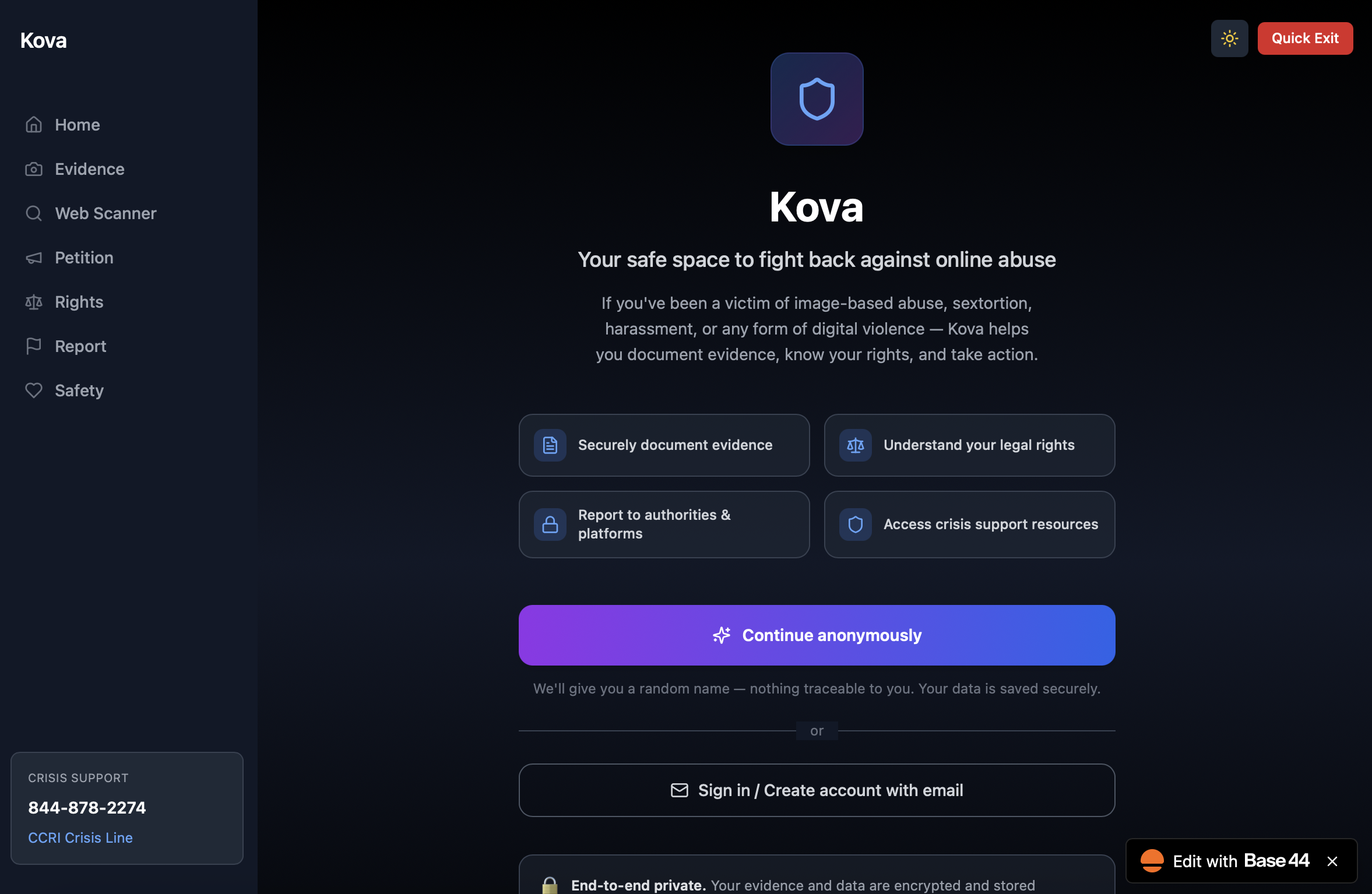
Pictured: The KOVA App developed by Jad & Alexia
Jad and Alexia weren't sure they wanted to enter last year’s Rule of Law Innovation Challenge, or ROLIC. The annual event, hosted by Lawyers Without Borders, asks law students from around the world to research and propose creative solutions to legal challenges that LWOB encounters in our day-to-day work. Jad and Alexia, roommates and second-year law students at the University of Glasgow, sat at their kitchen table and reviewed the call for proposals. One topic piqued their attention: Technology Facilitated Sexual and Gender Based Violence (TF-SGBV).
TF-SGBV refers to any sort of sexual or gender-based abuse that occurs digitally or through the internet: deepfakes, non-consensual image sharing, or digital harassment, to name a few forms. It extends physical violence into the digital sphere. While digital harassment isn’t new, TF-SGBV is surging to the forefront of dialogues around online safety for women and girls following the launch of AI image generation tools. If you use social media (or are simply a person on the internet), you may have encountered AI-generated content deployed for ethically questionable — or even outright illegal — ends. Jad and Alexia had noticed it, not only in news stories and court cases, but in the lives of people they knew. They were struck not only by the scale of the abuse, but the lack of actionable responses for victims. Again and again, the prevailing advice seemed to be: go private, delete your accounts, log off. The instinct is understandable. But the effect is to concede that little can be done about online harassment.
Combing through a mountain of research — UN reports, case studies, platform policies — Jad and Alexia encountered versions of the same problem. The law, in many jurisdictions, has begun to catch up. Legislation against deepfakes and image-based abuse does exist. Rights are on the books. But those policies do little to assuage the anxiety and fear that victims experience when their intimate photos — genuine or AI-generated — are posted online, triggering blackmail threats from anonymous accounts. In those moments, justice may feel very far away indeed.
“Why is there no practical solution? Why are there no tools available to victims?” – Jad
TF-SGBV evidence is hard to document. Content on the internet today might be deleted by tomorrow, with no record that it ever existed. Reporting systems vary by platform and are often difficult to locate, slow, or unresponsive. Victims often don’t know, or can’t find, their options beyond simply logging off, effectively abandoning the very evidence they would need if they ever decided to pursue accountability. The gap isn’t legislative, at least not primarily. It’s the distance between a right that exists and a right that a person can actually use. “The law was there,” Jad explained. “What was missing was everything that makes the law accessible.”
They were studying jurisprudence at the time — working through questions about the rule of law, justice, and what legal systems owe to the people they're meant to serve. The overlap was hard to ignore, particularly the core idea that rights only function when people can understand and exercise them. A law that a victim cannot reach is not, in any meaningful sense, a protection. Rather than write another paper about the problem, or simply propose a solution, Jad and Alexia decided to build something themselves. The result is KOVA, an online evidence-tracking tool that gives victims of tech-facilitated sexual and gender-based violence the ability to know their rights, preserve evidence, and take action — all in one place.
“The most rewarding thing was knowing that you could potentially make a difference in someone’s life” – Alexia
KOVA provides a place for users to upload and preserve evidence with timestamps and unique hash codes, creating a verifiable record that persists even if the original content is deleted. Victims can use a reverse image search to find where their likeness has been used without their consent, then access jurisdiction-specific guidance on their available legal options, with separate pathways for adults and minors. Direct links to the reporting systems of major platforms mean victims don't have to go looking for them. And because discovery is often also a moment of crisis, KOVA includes helplines and grounding resources (such as breathing exercises) alongside the legal ones. KOVA is not a proposal or an abstract pitch deck — it’s a fully functioning website built by Jad using coding skills honed between lectures, term papers, and exams. The site aims to be an online resource that leads by example, preserving evidence without collecting or storing victim’s personally identifiable information. (As of publication, Jad & Alexia are still finalizing the website; it has not yet been publicly launched).
The ROLIC process pairs student groups with professional attorneys who mentor the students’ projects. In this case, Alexia and Jad were partnered with Beste, Tarek, and Agrata, three attorneys from Hitachi Energy. The team of mentors sought to broaden their thinking, challenge assumptions, and respond to concerns. Together, the group explored challenges about victim exposure (the solution: anonymity) and the differences in legal guidance depending on age (the solution: separate pathways). “Working with Jad and Alexia was genuinely inspiring,” Agrata said. “Their passion, preparation, and commitment to making a positive impact were evident from day one. We may have come in as mentors, however the experience reminded us that learning goes both ways. Their creativity and determination left a lasting impression on us, and we are excited to see them excel in their journey ahead.”
“We may have come in as mentors, however the experience reminded us that learning goes both ways.” – Agrata
ROLIC is meant to scaffold an education in the law by pushing students to think creatively about practical legal challenges that exist in the real world. The resulting projects give students the opportunity to contextualize and apply lessons from the classroom in the real world. While ROLIC is primarily an in-person event hosted in London, Jad and Alexia gave their presentation from Glasgow over Zoom and then learned they won while waiting for a bus in the pouring rain (they may have screamed from excitement upon hearing this news).
Participating in ROLIC — a chance decision based on subject matter that sparked their interest — shaped the future of Jad’s and Alexia’s legal educations, who had both planned to pursue careers in corporate law. Following their ROLIC project, they both applied to Glasgow's Emma Ritchie Law Clinic — one of the only sexual violence law clinics in the UK — and to a course in cybercrime law. Their first-place certificates, they report, are going up on the wall of their shared flat.
Technology-facilitated abuse is evolving faster than both institutions and individuals can track. Legal systems, platforms, and advocates are all trying to respond. KOVA is one answer to one part of that challenge — but the instinct behind it points toward something larger. Pondering the issue at their kitchen table, Jad and Alexia did not question whether the law existed, but whether it could actually reach the people who needed it. There is no single answer. But it is exactly the right question to be asking.