
Tomorrow’s Heroes: an Interview with Pro Bono Volunteer Stephen Mansfield
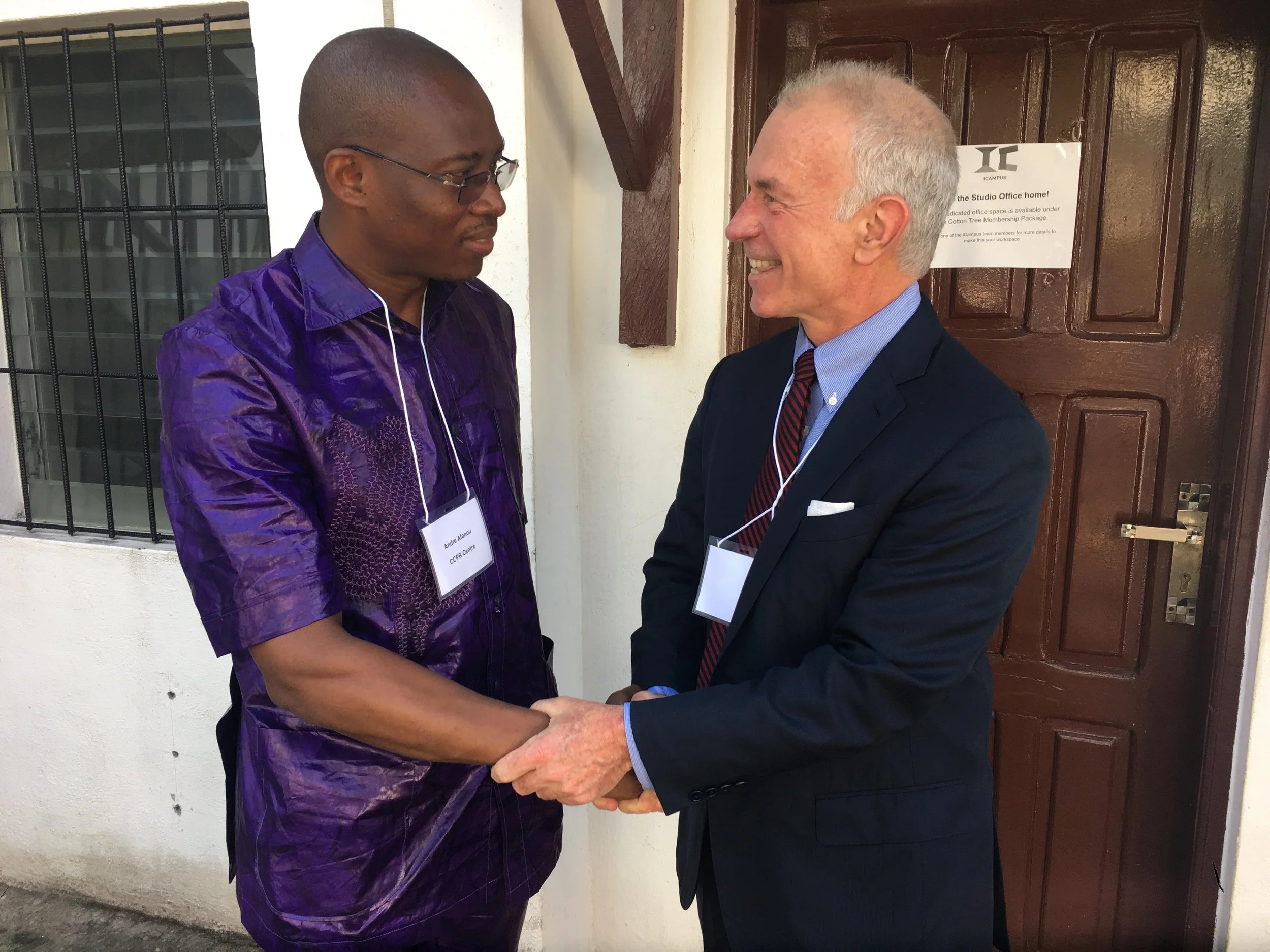
Pictured: LWOB Pro Bono Volunteer Stephen Mansfield shakes hands with a workshop participant
At a glance, Stephen Mansfield’s law career seems perfectly tailored to pro bono work for Lawyers Without Borders. Built on a deep interest in international human rights and rule of law, his work spans the gamut — from 11 years as a criminal prosecutor focused on political corruption and government fraud to leading the United Nations War Crimes Investigations Unit for Rwanda, where he oversaw the creation of a war crimes tribunal to prosecute individuals for their involvement in the 1994 genocide.
Still, he hadn’t heard of LWOB — not until his law firm, Akin Gump, approached him with a pro bono opportunity.
“The firm had developed a relationship with Lawyers Without Borders, which was looking for volunteer attorneys,” he said. “And I was contacted because the firm knew about my interest in international issues. So I started getting involved.”
How many times have you worked with LWOB, and what types of projects have you worked on?
I’ve participated in 10 or more projects from 2011 to 2019. Most of my involvement has been training prosecutors, law enforcement, and judges in rule of law and anti-trafficking programs in Kenya and Tanzania. Typically, that involves developing materials beforehand for brainstorming, coordinating the curricula, developing it and publishing it beforehand, and then teaching and providing feedback. The goal is to develop and train in-country trainers so the progress continues.
The organization is very good at scoping out the defined teaching/learning objective for various trips. They’ll assess where the need is, but part of that, I think, is also assessing the receptivity for training among government officials and institutions. Based on that information, we put materials together based on a country’s particular laws. Usually, we give lectures on the substantive issues involved, hold Q and A sessions and then, significantly, break down into groups so practitioners can perform like lawyers in realistic case settings. There are trained people there to observe and facilitate discussions within the groups about what worked and what didn’t, along with a larger discussion about what everyone has experienced and learned.
What do you like about the work? What do you get out of it?
I have a sense of positivity and encouragement about these younger lawyers who are the future of their country. They’re so excited, idealistic, and dedicated in their preparation and their work ethic. The participants must struggle with a very challenged rule-of-law system, with limited resources, and with enormous economic challenges and political corruption — and yet they are earnestly working hard to do their best for love of country and pride of professionalism. No sense of cynicism. They inspire. It’s a wonderful takeaway.
Do you have a sense of how those trainings have resonated with participants?
From my interactions, they feel better for having done it, and that their lives have changed as a result. I had the opportunity to critique a young woman prosecutor in Kenya who gave an absolutely brilliant closing argument and addressed some complex issues very forcefully and persuasively, the only feedback I could give was: “Outstanding.” If you could have seen her face — smiling, with so much pride — you would have seen a lawyer beaming with a confidence that will carry her forward.”
The participants are selected because they’re top-notch. The dream, the hope, is that having this positive experience will help them continue to further the rule of law in the future. And hopefully, because of their training, they will occupy positions of authority where they can make a difference.
Do you hear from, or receive updates on, past participants?
There have been ongoing follow-up discussions with some. The best example of this was after a training session in Nairobi, which had been inadvertently scheduled on a Friday that was a Kenyan national holiday. Friday was the culmination of the course, the mock trial. That’s the big day, when everything comes together and participants get to strut their stuff. But this conflicting holiday was one where most people take off from work and spend time with their families. And we only learned of it Thursday afternoon.
So we all show up on Friday, not really knowing what to expect. It unfolded like a scene from a movie. One after another after another showed up on time. We almost had full attendance of the approximate 80 people in this class. We spent the day productively going through the workshops and the mock trials. At the end, we made sure to thank them. I gave a bit of an impassioned thank you speech — to the effect, “it’s so impressive that you came in on your holiday and gave up time with your family. It really shows how dedicated you are.”
And then the Kenyans all stood and surprised us. Their leaders said, “no, thank you,” and asked if we would please allow them to sing their national anthem. They did. It was so beautiful leaving many of us in tears.
That training was focused on wildlife poaching and terrorism cases, and on the flight home I just kept thinking that these young people were tomorrow’s heroes for Kenya. And I started to write a song about it.
I titled it “Kenyan Heroes,” and I just kept writing for the entirety of my flight home. I was traveling with a guitar, and during a layover in Amsterdam I went into this room in the lounge and ran through what I’d written and recorded it so I could hear it back. By the time I got home I felt like I had a thank-you song for the Kenyans. I went to a music studio and recorded it with a friend. By this time it was close to Christmas, so when I sent the finished product to my Kenyan colleagues, I said, “this is my way of saying thank you for what you all have done in the program. Here’s my Christmas gift to you.”
I have never received more friendly emails in my life. I must have gotten 40 or 50 of them during the Christmas season, all with beautiful, poetic, appreciative language.
Have your experiences volunteering with LWOB changed the way you approach your work here?
I don’t think it affects the way I think about the practice of law, but it does affect my general outlook. When you’re just consuming news, regardless of the source, it’s easy to get pessimistic and cynical about everything. But when you get out there and get involved, and you meet the people, the folks on the ground, doing the best in the situation they have, it is encouraging. It creates, for me, a very positive outlook on the world.
Does this type of work take on new importance for you given the current restrictions on foreign aid and the hostile relationship between the current administration and various law firms?
In the spring of 2025 is when the administration had all these cutbacks, including funding for the Atrocity Crimes Advisory Group for Ukraine, which I was involved in, through the state department, helping Ukrainians investigate and prosecute war crimes. It’s a three-entity unit, with lawyers from the US, the UK, and the EU. The EU and UK lawyers moved forward, but the US operation was gutted.
It’s deeply frustrating and disappointing and sad. It’s very hard to make progress on these things, because international issues are so incredibly complex. The challenges are bigger, and moving forward requires more effort and collaboration. So to have this kind of disruption when you are making progress, and are in the middle of the work, is unimaginably frustrating.
Because the work matters. Rule of law issues are important for every country, everywhere. It costs, percentage-wise, very little to continue the work, and the gains are immeasurable. There is a documented strategic benefit of being present in these countries. It allows us to stay on top of issues — health, legal, economic — that affect us all. And to help further develop rule of law systems. There are so many advantages to all of it.