
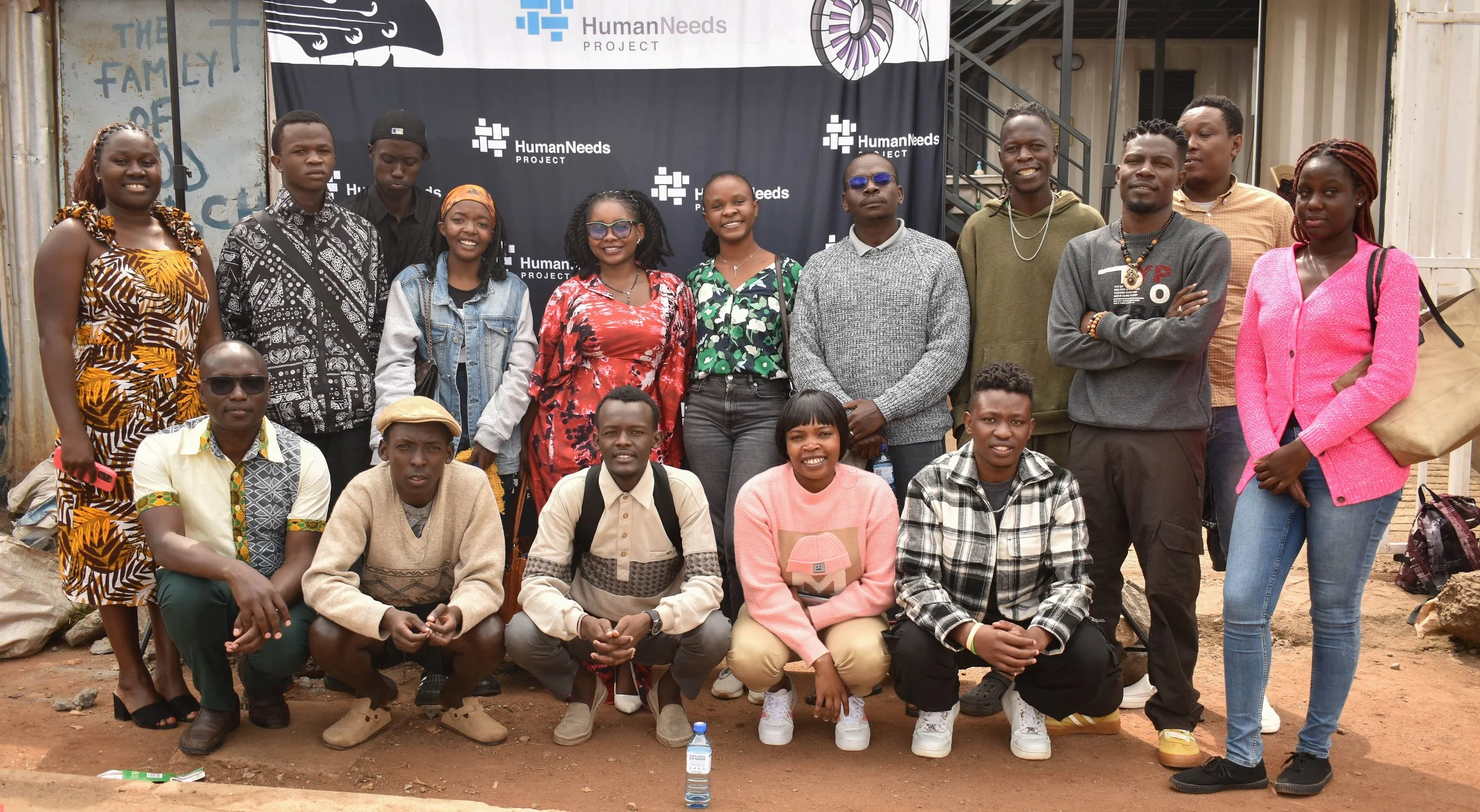
Pictured: a group of intellectual property workshop participants in Kibera, Nairobi.
Roughly 6.5 kilometers outside of Nairobi’s bustling Central Business District sits Kibera, the largest urban slum — and informal settlement — in all of Africa. The area is densely populated, with approximately 250,000 people residing across just 2.5 square kilometers. Most live in single-room shacks with dirt floors, corrugated metal roofs, and limited access to clean water, plumbing, and electricity. At first glance, it isn’t a place you’d expect to find a vibrant cultural scene, filled with original music, digital creators, and artists. But looks can be deceiving.
“Kibera is home to a really budding creative industry,” said Yvonne Abungu, an attorney based in Nairobi. “There’s a lot of talent there — street theater, hip-hop musicians, artists creating sculpture from metal and bone, digital content creators.”
For most, those creative endeavors haven’t translated to reliable income. It isn’t for lack of talent, Yvonne noted — or lack of demand. For years, Kibera’s artists and entrepreneurs have watched their work flourish outside of their own control. International tourists purchase sculptures at rock-bottom prices, then resell the pieces at huge markups, with none of the profits benefiting the artists. Digital platforms sample original music, without paying royalties to the musicians. Few creators sign contracts; those who do are often locked into dubious agreements that relinquish the rights to their intellectual property for pennies on the dollar, with no potential for future earnings. Most don’t view their work as intellectual property — or understand what “intellectual property” means.
It’s a broken system that disenfranchises creators, depriving them of basic rights in a way that perpetuates economic inequity. At its core, the problem began with a lack of knowledge, Yvonne said.
“Most simply had no awareness that talent could translate to revenue,” she said. “The goal was to help them protect that work.”
A Team Effort
To meet the need, Lawyers Without Borders assembled two teams of pro bono partners — one to produce legal guidance and a plain language primer on contracts for emerging artists; another to prepare a toolkit to help creators navigate the robust existing legal framework in Kenya. The resulting project — a collaboration between LWOB, the Human Needs Project’s Kibera Town Centre, and legal teams from Hitachi Energy, Jenner & Block, Morgan Stanley, and WilmerHale — aimed to help artists, musicians, and creators understand the value and potential of their own work through a series of trainings that focused on the basics of intellectual property.
“It was a matter of creating awareness — that this is your property, and it is actual property,” Yvonne said. “You can earn money from this.”
The general work — a how-to guide on contracts and legal guidance in the area of intellectual property — was not an unusual assignment for law firm partners. But the specific application was unusual, according to Chris Tickle, US Head of Technology Advisory at Morgan Stanley, who worked on the project from New York with colleague Sally Ebanoidze and a team from WilmerHale.
“The issue, which is broad, is that underrepresented and potentially marginalized individuals without access to relevant support may be at a disadvantage relative to the people purchasing their goods and services. What we’re looking to contribute is just fundamental contracting principles. The issue doesn’t surprise me,” he said. “But the nature of this work — the focus on art and performance— was kind of a surprise.”
The group focused on six areas related to intellectual property, trading drafts back and forth before eventually consolidating their work into a single how-to guide. The information was tailored specifically to creators rather than lawyers, with an emphasis on the key components of contractual agreements designed to protect intellectual property.
“We highlighted what we think are the most important considerations, which is really the general principle that when you create a song, or are performing, or providing some sort of artistic service, you have to have a contract that establishes who is doing what, in what time, and that addresses ownership and payment,” Chris said.
“If there is one lesson we would hope to leave with a local artist and small business owner, it is this: always err on the side of specificity, and clearly articulate the detailed obligations of each party,” added Reid J. Carroll, senior associate with WilmerHale.
Preparing a legal toolkit to help artists navigate the existing bureaucracy in Kenya was somewhat less straightforward, said Abi Dore, practice counsel at Jenner & Block in London. She worked on the project with colleagues Christine Braamskamp and Michaela Croft, along with an in-house legal team at Hitachi Energy.
‘The work involved, to start, going and looking at what there was in terms of legislation, case law, and regulation. And we discovered that, actually, Kenya has a really well developed system, with loads of legislation and a lot of different systems and procedures,” she said. “There was so much of it, and the body was so extensive, that of course it becomes almost impossible for an individual to really know even what specific type of IP they're creating, let alone how to protect it.”
The team split the work into two phases, starting by preparing the legal memorandum by working on the same document, filling in details about specific pieces of relevant legislation. From there, Abi, Christine, and Michaela worked to streamline the language, translating legal jargon into less formal wording that artists (and non-lawyers) could easily understand.
“We wanted to prepare something that artists on the ground could use, so phase two focused on turning that memorandum into a more practical toolkit, with, for example, links to registration websites rather than a high-level assessment of all the different legal procedures,” Abi said. “We also included a summary of the basics. What is your intellectual property? What are your rights? How can you profit from it?”
Before the materials were finished, they made a stop in Kibera. LWOB shared early drafts with staff at the Kibera Town Centre, gathered their feedback, and added recommendations drawn from years of its own rule of law programs around the world. Those notes went back to the pro bono teams, and the final versions gained more accessible examples and a summary of the basics.
The work was Abi’s first pro bono project at Jenner, and the experience had practical applications for her regular job. It was the first time she’d drafted a legal memorandum, and she found value in the project management experience, she said.
“But it was also just really nice to do something that was very different to what I do,” she said. “That’s something that’s really nice about pro bono work. You get to try things that might not necessarily be completely related to your everyday work, but it’s interesting, and rewarding, anyway.”
Back in Kibera
The training, held on June 19th, 2026, used the prepared materials to introduce creators and entrepreneurs to copyrights, contracts, licensing, and “protecting creative work in an increasingly digital economy.” Sessions included examples of artists who had successfully sued to protect their work, as well as education on basic topics, like the difference between a trademark and a copyright. Most participants, Yvonne said, were shocked to learn that their artistic endeavors could also generate real income.
“Many had been disenfranchised and were, as a result, feeling low about creating,” she said. “Because of that, we really led with, and leaned into, this idea that they have support. The Law Society of Kenya is behind you. The law does not protect ignorance, so if you have questions, just ask somebody. We gave them reassurance — ‘this is your property, and this is how you fight for it.’ At every point, we repeated this: ‘We are behind you.’”
Those aren’t empty sentiments, she added. Human Needs Project is currently partnering with the Kenyan Judiciary and the Law Society of Kenya to set up a permanent legal aid camp within the Kibera Town Centre, where artists can access template contracts and receive in-person guidance from licensed attorneys. The ongoing support aims to nurture and maintain the sense of empowerment artists felt by the end of the training, moving the region closer to the ultimate goal of a more equitable economy.
The benefits reach beyond individual artists. When creators can protect their work, more of the value they produce stays in Kibera. Artists who earn fair pay and ongoing royalties can afford to keep creating, invest in their craft, and spend and hire locally, turning talent that was once easy to exploit into a lasting source of income for the community. Protections that have long been available mainly to artists with agents and lawyers are now within reach of creators who never had that support, and a local creative economy built on that footing is both fairer and more likely to last.
“They left feeling empowered and educated, because education is power,” Yvonne said. “It’s one step toward banding together, fighting for rights, and learning to protect each other.”